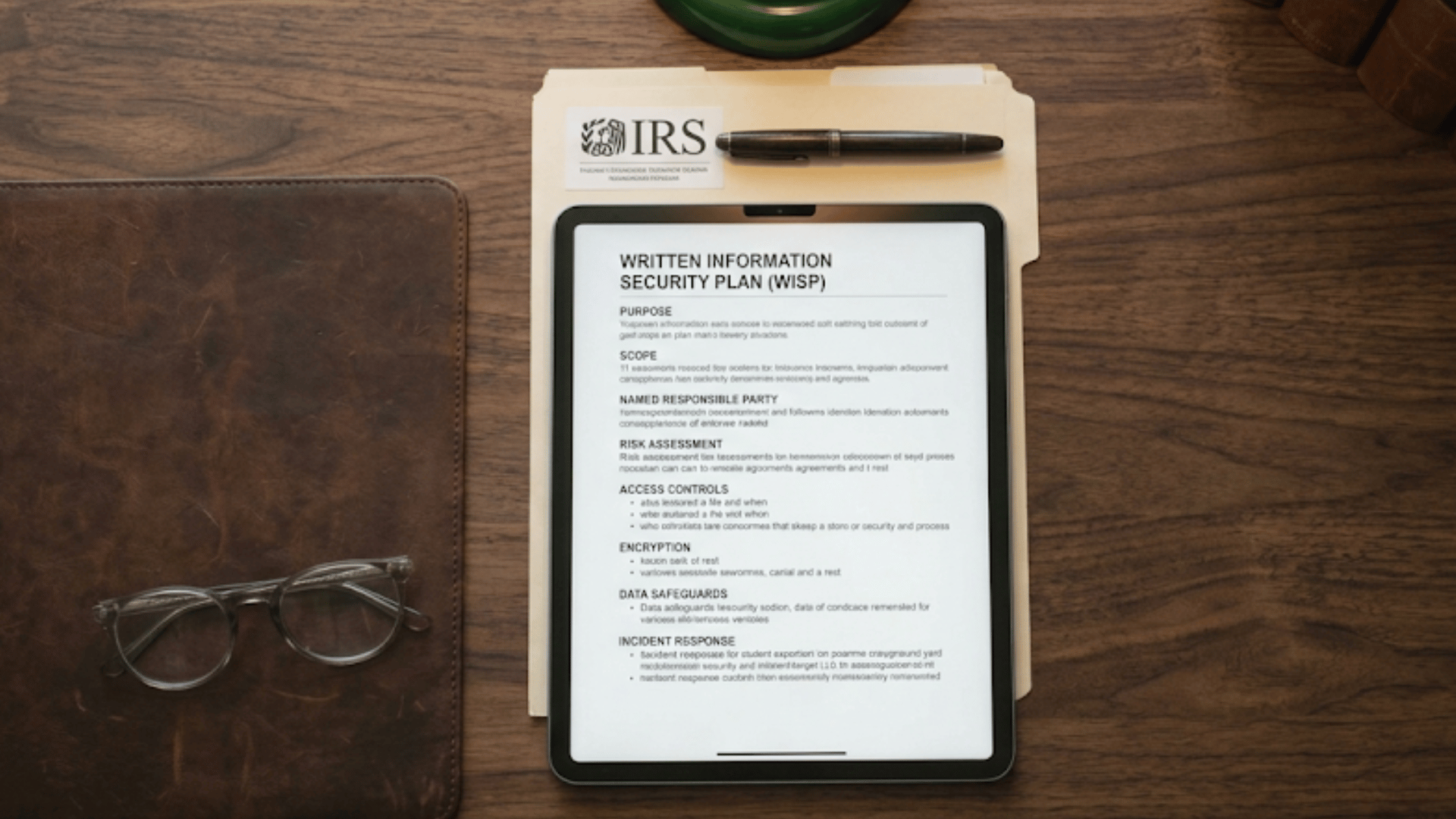
Most tax firms treating IRS Pub 4557 compliant file sharing as a solved problem have the same blind spot: they control the outbound leg, not the return path. They have encrypted email gateways, maybe a portal, possibly a ShareFile or SharePoint folder. Their Written Information Security Plan names a responsible party and describes the controls in place. On paper, the compliance narrative holds.
In practice, client PII flows through unsecured channels every busy season anyway.
The reason is structural, not technical. Pub 4557 compliance is a two-sided problem: the firm controls its outbound leg, but the inbound leg belongs to whatever the client finds easiest. When those two legs run on different channels, the firm’s encryption does nothing for the data that comes back. The WISP describes one world; April looks like a different one entirely.
The only defensible compliance model is channel consolidation, not channel addition. The behavioral benchmark is consumer banking, not enterprise security architecture.
Key takeaways
- IRS Publication 4557 requires every tax preparer to maintain a Written Information Security Plan covering six control areas: a named responsible party, a formal risk assessment, access controls, encryption in transit and at rest, safeguards for third-party service providers, and an incident response plan.
- The FTC Safeguards Rule (16 CFR Part 314), amended in 2023, runs parallel: tax preparers qualify as financial institutions and must meet its own qualified-individual, risk-assessment, and technical-safeguard requirements.
- Pub 4557 compliant file sharing means every leg of every client data exchange, outbound and inbound, is encrypted, logged, and documented in the WISP. A firm that encrypts its outbound sends but accepts unencrypted client replies via text or personal email is not compliant, regardless of what the WISP states.
- Channel consolidation, one encrypted, mobile-first, access-logged channel for all client document exchange, is the only architecture that satisfies all six Pub 4557 control areas simultaneously.
What IRS Pub 4557 Actually Requires
IRS Publication 4557, Safeguarding Taxpayer Data requires every tax preparer to maintain a Written Information Security Plan that addresses six control areas: a named responsible party, a formal risk assessment, access controls, encryption in transit and at rest, safeguards for data held by service providers, and an incident response plan.
Read those six requirements as channel-design constraints rather than a checklist, and the implications become concrete:
- Named responsible party means someone in the firm owns the consequences when a channel fails.
- Risk assessment means the firm has mapped every path taxpayer data travels, including the return paths from clients.
- Access controls means the firm can show who touched a file and when, on every channel the firm accepts.
- Encryption in transit and at rest means data is protected on every leg of every exchange, not just on the firm’s outbound send.
- Incident response means the firm knows, within hours, which clients are affected when a channel breach occurs.
The FTC Safeguards Rule (16 CFR Part 314), as amended in 2023, covers the same firms under a parallel regime. Tax preparers qualify as “financial institutions” under Safeguards, which imposes its own qualified-individual requirement, risk assessment mandate, and technical safeguard standards. Firms that treat Pub 4557 as optional sometimes discover the Safeguards Rule is not.
IRS Publication 5708, Creating a Written Information Security Plan provides a plain-language WISP template for tax professionals. It requires the WISP to document every channel the firm uses for client data exchange, the controls applied to each channel, and the firm’s process for detecting and responding to a breach on any of them.
That last requirement is where multi-channel firms run into trouble.
The Encrypted Email Round-Trip Problem
Encrypted email is the most common control tax firms list in their WISP. It is also the most common point of failure.
Here is the failure mode. The firm sends a completed 1040 draft as an encrypted email attachment. The client opens it on a phone. The client has a question about a K-1 line. The client screenshots the K-1 page and texts it back to the staff member’s cell phone with the question typed below it.
The firm’s encryption did nothing. A screenshot of a K-1, containing the client’s Social Security number and partnership income, is now sitting in the staff member’s SMS thread, backed up to iCloud, and retrievable by anyone with access to that phone. The WISP says “encrypted email for all client document exchange.” The WISP is now inaccurate as a description of what actually happened.
Encryption on the firm’s outbound leg does not compel encryption on the client’s inbound leg. The client does not have an encrypted reply workflow. The client has a phone and whatever method is fastest. That is almost never encrypted reply.
This is not a theoretical risk. It is the default behavior of most clients receiving a file via encrypted email on a mobile device. The IRS Security Summit guidance and Taxes-Security-Together Checklist names encryption as one of the “Security Six” controls every tax firm must demonstrate, but demonstrating encryption on the send does not close the loop if the receive path is open.
Multi-Channel Drift and the WISP Surface Problem in IRS Pub 4557 Compliant File Sharing
A single encrypted email failure is manageable. The larger problem is what a typical firm accumulates over one busy season without intending to.
By late March, a firm is often running something like this: encrypted email for the clients who set it up, generic ShareFile links for the ones who won’t install anything, a portal login three clients actually use, texted photos from a spouse who never got the portal invite, and a paper drop-off from the client who still prefers it.
Each of those channels carries different compliance characteristics under Pub 4557 and the FTC Safeguards Rule. Each requires its own access logging, its own retention policy, its own breach notification trigger, and its own entry in the WISP. A defensible WISP does not just say “we use encrypted channels.” It documents each channel, its controls, and the firm’s incident response procedure for that channel specifically.
Five channels means five distinct risk profiles the firm’s responsible party must manage, monitor, and report against. Five channels means a breach on one channel requires identifying which clients used that channel, what data passed through it, and who had access. Five channels means staff, under April pressure, are making judgment calls about which method to use for which client, and those judgment calls are not uniform.
The AICPA’s information security resources for tax practices frame secure client communication as a professional-standards obligation, not just a regulatory one. Every additional “acceptable” method the firm tolerates multiplies the audit surface and the failure modes in the WISP. Tolerating five channels and adding a sixth makes it worse.
The Banking-App Benchmark
Chase and Bank of America moved statements, secure messages, document upload, and identity verification into one mobile experience. Clients adopted it, not because of the compliance copy in the account agreement or the security disclosures in the onboarding email, but because it was easier than the alternative. Logging in to check a statement became easier than calling. Uploading a check photo became easier than going to a branch. The secure channel became the default channel because it was the better channel.
The behavioral logic is the same for a tax firm. If the firm’s secure option requires a portal password the client reset twice last year and still cannot find, the client will text the W-2 instead. If the secure option generates a PDF the client cannot read on a phone without downloading it and opening it in a separate app, the client will email a photo instead. Compliance language in the engagement letter does not change this. Clients route around friction, not policy.
Compliance holds only when the secure channel is also the most convenient channel for the client. One mobile-first destination for messages, documents, tasks, and signatures. Better UX than the insecure alternative. Adoption follows the path of least resistance, and the firm’s job is to make sure that path is also the compliant one.
A firm cannot reach this state by adding another layer of security to email. Email is the problem. Adding encryption to email still leaves the round-trip exposure, still requires the client to know how to reply securely, and still produces the texted-screenshot outcome described above or the more-common unencrypted email reply. The only exit from the round-trip problem is a channel the client prefers to use, with encryption and access logging built into the channel itself rather than bolted onto a legacy communication medium.
What IRS Pub 4557 Compliant File Sharing Looks Like in Practice
Firms are required to address the round-trip vulnerability in order to remain compliant. That requires a client-facing channel that does all of the following, or the WISP remains aspirational:
Encryption in transit and at rest, built into the channel. Not encryption on the send and hope on the return. The channel itself must encrypt data in both directions, at rest in the firm’s environment, and at rest on whatever server the client’s documents touch.
Access logging by client and by document. The WISP’s named responsible party needs to be able to produce a log showing who can access and who has accessed a specific client’s files, when, and from what device. A channel that does not generate this log cannot satisfy the access-control requirement in a documented way.
Mobile-first document upload. If the client cannot upload a W-2 photo from a phone in under thirty seconds, the client will text or email it instead. The secure channel must match or beat the friction of texting. This is not a nice-to-have; it is the behavioral precondition for the channel working as the compliance model requires.
Secure messaging in the same place documents live. The K-1 screenshot problem happens because the client has a question and the only tool they reach for is their mobile device. When messaging and documents share one place, the K-1 question gets answered inside the channel, not outside it.
A single audit surface. One channel means one set of access logs, one retention policy, one incident response procedure, one entry in the WISP. A breach means the firm knows immediately which clients are affected, because there is only one channel to audit.
Liscio operates as the File Intelligence layer behind that client-facing exchange. When documents arrive through the channel, File Intelligence identifies, structures, and routes them against the request list for each client and year, so received files are matched and made useful rather than just stored. Firms using Liscio’s apps and text messaging report 8x faster client response than email. Online and portal clients return organizers at 80%+ rates (paper clients excluded). Liscio holds a SOC 2 Type 1 attestation and the platform is built for accounting document workflows, not adapted from a generic file-sharing tool.
Industry data suggests 40%+ of an accountant’s time goes to gathering documents and chasing clients. Channel consolidation reduces compliance risk and recovers working time from the parts of the job that generate no billable value.
The Honest Frame on Consolidation
Channel consolidation is what Pub 4557’s requirements describe when you read them as channel-design constraints rather than a checklist.
A firm that documents one client-facing channel in its WISP can satisfy the named-responsible-party, risk-assessment, access-control, encryption, and incident-response requirements in a straightforward way. A firm that documents five channels has five risk surfaces to map, five access-log systems to maintain, and five incident-response procedures to follow. The compliance burden scales with the number of channels, and busy-season drift tends to increase that number, not decrease it.
The firm with the strongest encryption stack is often the least Pub 4557-compliant in practice, because strong encryption on one channel does not prevent clients from using four other channels that are not encrypted. The encryption investment without consolidation clarifies which channel the firm controls, and which channels it does not.
The audit-defensible position is not “we encrypt.” It is “clients do not have another channel to fall back to, because ours is better than the insecure alternative.”
For questions about breach-notification thresholds or state-specific data protection requirements that go beyond Pub 4557 and the FTC Safeguards Rule, consult counsel. State statutes vary, and the interaction between Pub 4557, the Safeguards Rule, and state law is a legal question that falls outside the scope of this piece.
Frequently asked questions
See how Liscio works: Book a demo