In a rolling wave of announcements to clients in 2025, Thomson Reuters informed customers that FileCabinet CS will be discontinued in December 2027. For the 12,000+ accounting firms using FileCabinet CS as their primary document management system, the FileCabinet CS migration guide becomes critical — firms have to navigate a narrow window to find, implement, and fully transition to a new platform. If you're waiting until 2027 to start your FileCabinet CS migration planning, you're going to face a problem.
The FileCabinet CS migration window is shorter than it appears. According to the AICPA's 2024 MAP Survey, the average software migration for accounting firms takes 4–6 months from vendor selection to full deployment. Factor in vendor selection, staff training, and the reality that no firm wants to change document systems during tax season, and your effective deadline moves up significantly. Firms that wait until 2027 to begin this process will be competing for the same migration specialists and support resources as thousands of other practices facing the same deadline.
Why Thomson Reuters Is Discontinuing FileCabinet CS
Thomson Reuters' $600 million acquisition of SafeSend in January 2025 signals where the company is placing its strategic bets. The acquisition, combined with their ongoing focus on upper-tier solutions like GoFileRoom, reveals a clear pattern: Thomson Reuters is prioritizing higher-priced solutions for larger firms with 25+ employees. This strategic shift makes FileCabinet CS customers — predominantly smaller practices — a lower priority for development and ongoing support.
This puts smaller, resource-constrained firms in a difficult position. The products Thomson Reuters wants to migrate you to are built for larger practices with different budgets and IT requirements. For many FileCabinet CS users, the recommended migration path within the Thomson Reuters ecosystem represents a significant cost increase for functionality they may not need.
FileCabinet CS Migration Options: From Free to Full-Service
The good news is that you have more FileCabinet CS alternatives than Thomson Reuters' internal migration path. Here's what firms are actually choosing:
Microsoft SharePoint: The Emerging Leader
Many firms are discovering that Microsoft SharePoint offers a compelling FileCabinet CS migration target. It's already included in most Office 365 subscriptions, provides enterprise-level security controls, and integrates seamlessly with the Microsoft tools most accounting firms already use daily. For firms already paying for Office 365, the marginal cost of using SharePoint for document management is zero.
The challenge with SharePoint is the gap between its generic capabilities and accounting-specific workflows. Several solution providers now offer purpose-built layers that bridge this gap, providing accounting-specific organization, client portals, and time-saving workflows while keeping SharePoint as the underlying document store.
Profession-Specific Document Management Solutions
Purpose-built platforms designed exclusively for accounting firms offer the smoothest FileCabinet CS migration path with minimal workflow disruption. These solutions understand accounting document types, client communication patterns, and integration requirements specific to the profession.
Liscio, for example, offers SOC-compliant document management with file migration completed in less than a week, at less than half the cost of a Thomson Reuters migration path. The platform's File Intelligence system automatically identifies, tags, and renames incoming client files to match your firm's standard — saving hours of administrative time each week and making retrieval effortless.
Cloud Storage Plus Workflow Tools
Some firms are choosing to separate document storage from document workflow, using cloud storage solutions (Box, Dropbox Business) for the storage layer while adding accounting-specific tools for client communication and document processing.
The Cost of Delaying Your FileCabinet CS Migration
Firms that delay their FileCabinet CS migration decision until 2026 or 2027 will face two significant penalties: higher implementation costs and potential service disruption.
Migration specialists and implementation partners have finite capacity. When thousands of FileCabinet CS users hit the market simultaneously in late 2026 and 2027, demand for migration services will far exceed supply. This creates both pricing pressure and scheduling challenges. The firms that start their vendor evaluation process in 2025 will have more negotiating leverage and more implementation options.
Thomson Reuters has not committed to maintaining FileCabinet CS feature updates or integration compatibility through the end-of-life period. Waiting until the last minute creates the risk that your current system becomes increasingly difficult to maintain as other software vendors update their integration points.
FileCabinet CS Migration Timeline: What You Need to Know
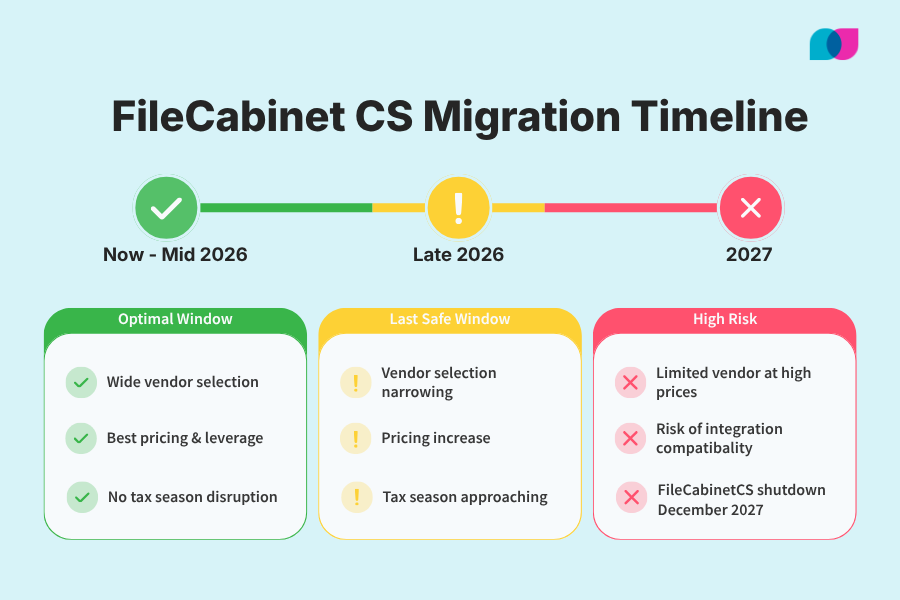
Based on AICPA survey data showing 4–6 month average migration timelines, here's the realistic calendar for FileCabinet CS users:
Now through Summer 2026: Vendor evaluation and selection. This is the optimal window to compare options, negotiate pricing, and select your migration target without time pressure. Firms starting today still have a comfortable runway.
Late 2026: Implementation deadline for firms that want to avoid tax season disruption. Starting no later than October 2026 ensures full deployment before 2027 tax season preparation begins.
2027: High-risk migration period. Limited vendor availability, premium pricing, and potential for service disruption. Firms that wait until 2027 will be competing for the same migration resources as thousands of other practices facing the same deadline.
What to Evaluate in FileCabinet CS Alternatives
As you begin evaluating FileCabinet CS alternatives, focus on these critical requirements:
- Time savings: Which platforms include accounting-specific workflows that remove administrative overhead?
- Migration support: How does each vendor handle the actual file transfer from FileCabinet CS? What is their track record with accounting firm migrations? How long does the process typically take?
- Security and compliance: Does the platform meet your SOC requirements and client data security standards? This is non-negotiable for accounting firms.
- Total cost of ownership: Look beyond the monthly subscription fee. Factor in migration costs, training time, and any required hardware or software changes.
Frequently Asked Questions About FileCabinet CS Migration
Q: How long does a typical FileCabinet CS migration take?
A: Based on AICPA survey data, accounting firm software migrations average 4–6 months from vendor selection to full deployment. The actual file transfer typically takes 1–2 weeks, but vendor evaluation, staff training, and workflow adjustments extend the timeline. Purpose-built accounting solutions like Liscio can complete file migration in under a week, while generic platforms may require longer implementation periods.
Q: What happens to my FileCabinet CS data after December 2027?
A: Thomson Reuters will provide data export capabilities before the shutdown date, but firms are responsible for completing their own data migration. The company has not committed to maintaining access beyond December 2027, making it critical to complete your migration well before the deadline. Any delay risks data accessibility issues or emergency migration scenarios with limited vendor support.
Q: Should I migrate to another Thomson Reuters product?
A:Thomson Reuters offers migration paths to GoFileRoom and other enterprise solutions, but these products are designed for larger firms with different budgets and IT requirements. Many FileCabinet CS users find these alternatives represent significant cost increases for functionality they don't need. Evaluating purpose-built accounting solutions or SharePoint-based alternatives often provides better cost-to-value ratios for smaller practices.
Q: Can I migrate FileCabinet CS data to multiple platforms?
A: Yes, most migration specialists can split your FileCabinet CS data across different platforms based on your workflow needs. Some firms migrate active client files to a document management platform while moving archived files to lower-cost cloud storage. However, splitting data creates complexity in search and retrieval, so evaluate whether the cost savings justify the operational complications.
Thomson Reuters' discontinuation of FileCabinet CS represents both a challenge and an opportunity. While no firm wants to be forced into a software migration, the end-of-life announcement gives you nearly three years to make a deliberate, strategic decision about your document management platform. Firms that approach this FileCabinet CS migration thoughtfully — starting the evaluation process now rather than waiting for the deadline — will end up with better solutions at lower costs.
The accounting profession has more document management options available today than at any point in its history. Use this migration requirement as an opportunity to evaluate what your firm actually needs, not just what you've always used.
Ready to move your files out of FileCabinet CS?
Liscio migrates your files in less than a week, at less than half the cost of a Thomson Reuters migration path.
See how Liscio's FileCabinet CS file transfer service works →