AI Document Processing for Accounting Firms: Accuracy, Speed, and Cost

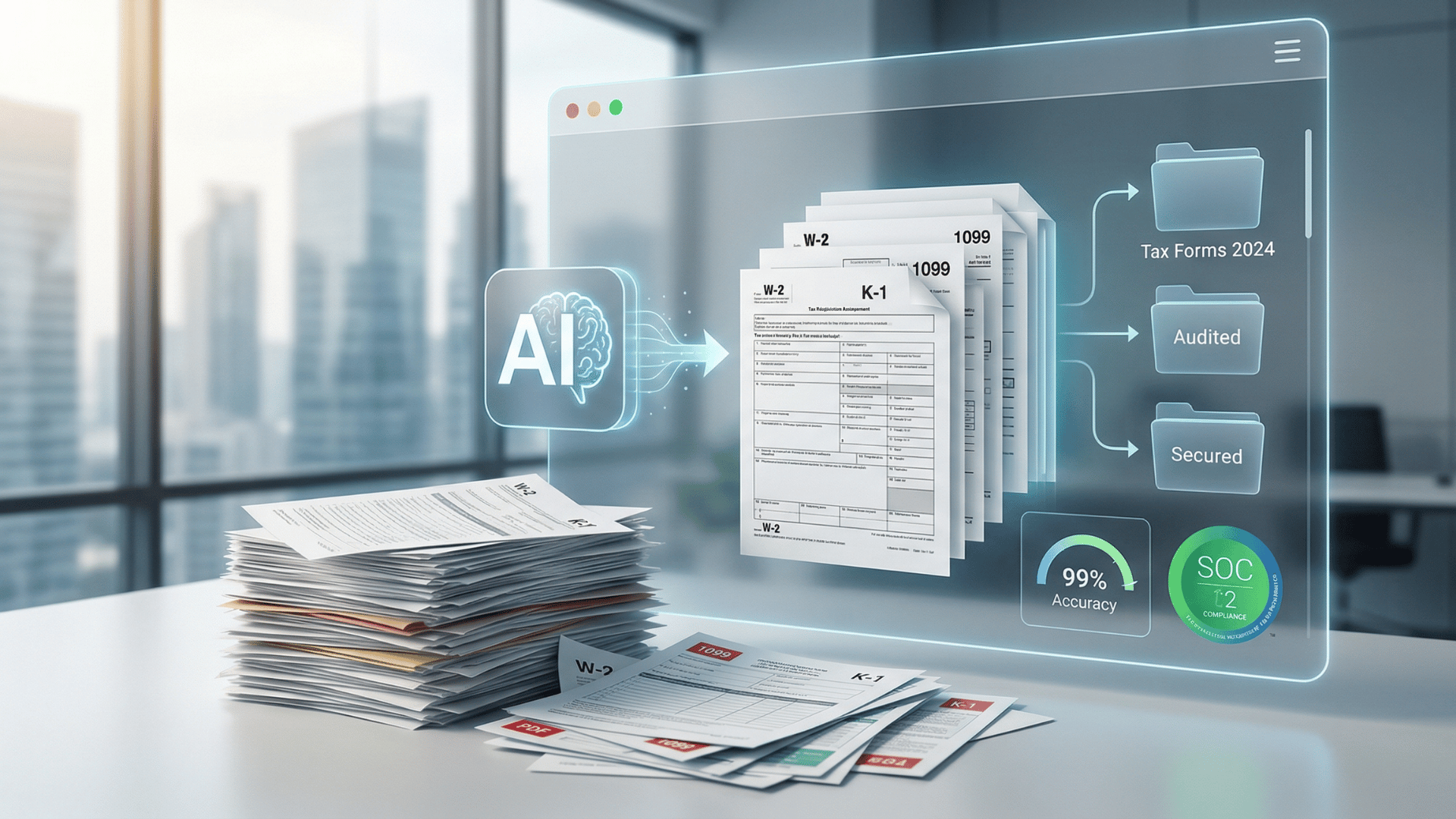
AI document processing for accounting firms fixes the administrative nightmare: renaming files, filing and tagging documents, and searching for what you need. These are tasks nobody went to school for, yet they consume professional time. The generic tools firms rely on—consumer OCR, generic AI, and file storage—were not built to handle the compliance and precision demands of tax and accounting. The result is wasted hours, uncertainty about client files, and constant friction during preparation.
Liscio is purpose-built for accounting document processing. It understands accounting terminology, document types, and the absolute precision and security your firm requires. The result: hours saved every week, with documents automatically organized, instantly accessible, and ready to use, backed by 99%+ accuracy on core tax and accounting forms including 1040, W-2, 1099 series, and K-1s.
Why Generic AI Document Processing Tools Fail for Accounting Firms
Generic AI tools were not built for accounting. That is not a gap you can configure your way around—it is a fundamental mismatch.
- They guess. General-purpose AI is probabilistic by design. Accounting is not. When a tool misreads "1099-INT" as "1099-1NT" or mangles box numbers on a K-1, that is not a minor transcription error. That is a downstream risk that triggers rework, review cycles, and liability.
- They work outside your workflow. Consumer AI tools process documents in isolation. Every output requires manual handling to get it somewhere useful, which completely eliminates any claimed time savings.
- They were not built for your compliance requirements. SOC 2, data retention protocols, audit trails: most document tools cannot meet these requirements. Client tax data demands more than a general-purpose platform can offer.
- They cost more and deliver less. LLM-only architectures are expensive at scale and are far less accurate than purpose-built alternatives.
The right tool for automating document processing for accounting firms is not a general AI that can sort of handle it. It must be built for the job, end of story.
The Problem Starts Before Processing Even Begins
The first point of failure in document processing is almost always intake. Most conversations about AI document processing skip the first question: how did the document get there?
Email is not a valid answer. The IRS, Gramm-Leach-Bliley, and state-level data privacy regulations are explicit: sensitive financial information cannot be transmitted over unsecured consumer channels. A client emailing a W-2 to their CPA creates a compliance exposure. A firm using that unsecured channel to feed documents into any AI tool compounds the risk.
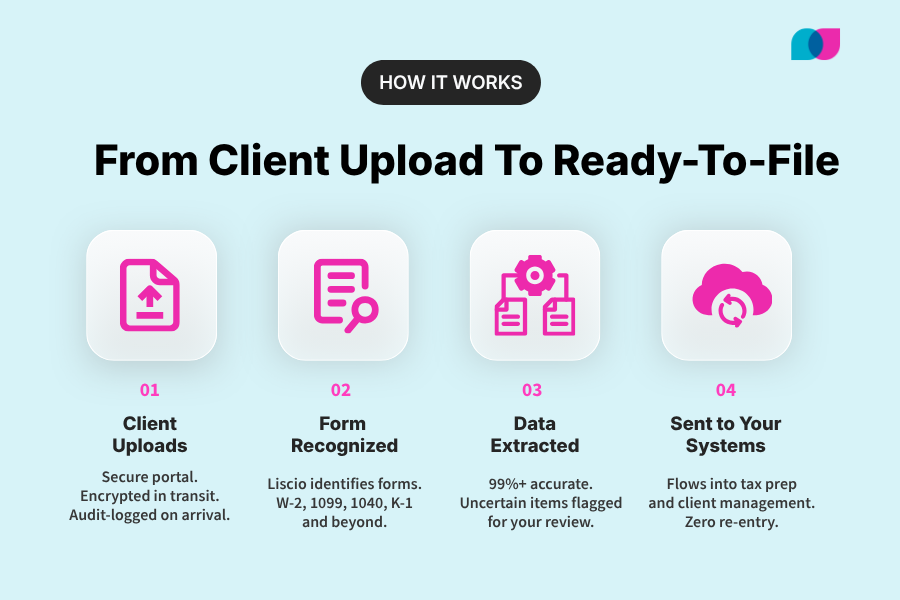
Liscio solves this by design. Documents arrive through a secure portal, encrypted in transit, access-controlled, and audit-logged from submission. The document enters a compliant workflow and stays in one. This matters because compliance is not a separate step; it is the prerequisite for all subsequent automation. By controlling secure intake, the firm ensures staff know exactly where documents are, and automation can begin instantly without manual uploading or downloading into a generic tool.
How Purpose-Built AI Document Processing for Accounting Firms Works
Liscio's hybrid architecture is built on a core principle: separate the work that requires precision from the work that requires judgment.
- Deterministic processing for standard forms: Standard tax forms—W-2s, 1099s, 1040s—follow predictable structures. They are best suited for processing by deterministic systems, not AI. Deterministic systems deliver predictable, verifiable results.
- Selective AI for exceptions: AI analysis should only be used for non-standard documents that require judgment calls, such as handwritten receipts, irregular bank statements, or complex edge-cases. Even here, AI use is selective, narrow, and part of a broader system with rigorous checks and balances.
This selective approach is what makes the accuracy numbers real. Training on accounting-specific document types means the system understands the difference between a 1099-INT and a 1099-DIV. It recognizes which details differentiate specific form types and how accountants categorize documents—it does not treat tax data like a generic text extraction problem.
When confidence falls below threshold on any extraction, the system flags it for human review rather than committing a best guess. Liscio suggests. You decide. Always.
Accuracy is the Critical Metric for Accounting Firms
Anything automated is faster than manual entry. Speed is not the bar. Accuracy is the bar, and specifically what happens to errors at scale.
At a 5% error rate across 1,000 documents, you have 50 problems distributed across your client base with no systematic way to find them. The correction cycle—identifying, locating, fixing, and re-reviewing—can cost more in professional time than the original manual entry would have.
The issue is not that AI is inherently ineffective—it's that it is being applied to problems that require near-deterministic outcomes. To address this, firms need a hybrid approach that moves toward deterministic outcomes rather than relying on probabilistic guesses. Liscio uses AI for a narrow sliver of the problem, while combining it with mature technologies such as positive and negative keyword mapping, visual form recognition, vector-based embeddings, and other techniques to triangulate document identity.
Liscio maintains 99% accuracy on core tax forms. For unstructured documents such as receipts, bank statements, and irregular invoices, accuracy stays above 95%.
Critically, the system does not guess. If confidence is low across any of the techniques used, no classification is made. Instead, the result is surfaced for human review. Precision where the structure permits it, transparency where it does not.
The practical effect: error correction cycles shrink dramatically. Staff spend time on genuine exceptions, not hunting for mistakes buried in extracted data.
Security and Compliance for Client Financial Data
Client documents don't just contain sensitive data, they contain regulated data. The processing infrastructure has to match the sensitivity of the data.
In practice, many firms fall short. Documents are collected through email or uploaded into general-purpose tools not designed to meet accounting requirements imposed by Federal and State regulatory bodies such as the IRS. The issue is not a single point of failure; it is that compliance must be maintained at every step: communication, intake, processing, storage, and deletion. If any part of the workflow does not meet required standards, the firm itself is out of compliance.
Liscio's SOC 2 compliance covers the full document lifecycle: intake, processing, storage, and deletion. Encryption applies in transit and at rest. Every document carries a complete audit trail showing when it was received, how it was processed, who reviewed it, and where corrections were made. Data residency and retention controls let firms align document handling with their own policies.
This is not a compliance layer bolted onto a general-purpose tool. It is the architecture the platform was built around, because the accounting firms who use it could not operate any other way.
Implementation and Integration
Liscio fits into existing firm workflows rather than replacing them. Extracted data flows directly into the tax preparation and client management systems your team already uses. No parallel data entry. No manual exports. Staff training focuses on exception handling: reviewing flagged items, making corrections, and confirming extractions on complex documents. The system handles the routine. Professionals handle the judgment calls.
Implementation timing matters. Tax season is the wrong time to change document workflows. Firms should plan rollout during lower-volume periods and validate against real document samples before going live at scale. The platform serves sole practitioners and large regional firms alike. Volume scales, but the underlying accuracy and compliance posture does not change with firm size.
Frequently Asked Questions
Q: What accuracy can accounting firms expect from AI document processing?
A: 99% on core tax forms including 1040, W-2, 1099 series, and K-1s, and 95%+ on unstructured documents like receipts and bank statements. That precision comes from training on accounting-specific documents and a hybrid architecture that applies deterministic processing to standard forms and AI analysis only where structure is absent or ambiguous. When confidence falls below threshold, the system flags items for human review rather than guessing. The result is a predictable, auditable error rate.
Q: Why can't accounting firms just use email and a general AI tool for document processing?
A: Gramm-Leach-Bliley, IRS guidance, and state privacy regulations prohibit transmitting sensitive financial data over email and other unsecured channels. Beyond transmittal, general AI tools process documents without accounting-specific training, produce errors that are difficult to locate at scale, and lack the audit trails compliance requires. Liscio handles document intake, processing, and storage within a single SOC 2-compliant environment. Compliance is not a separate problem to solve.
Q: Is AI document processing secure enough for client tax documents?
A: SOC 2 compliance, encryption in transit and at rest, detailed audit trails, and data residency controls are baseline requirements for handling client financial data. Liscio was built to meet these requirements, not retrofitted to them. Every document maintains a complete processing record: received when, extracted how, reviewed by whom, corrected where.
Q: How does AI document processing for accounting firms integrate with existing workflows?
A: Extracted data flows directly into tax preparation and client management systems, eliminating double-entry work. Staff interact with the system primarily through exception review: flagged items, low-confidence extractions, and cross-document discrepancies that need human judgment. The platform adapts to firm size and volume without changing the underlying accuracy or compliance posture.
Ready to see how purpose-built AI document processing works for your firm?
See how Liscio's AI document processing works →